
Modern Real Estate Lead Generation: Turning Website Traffic into Qualified Clients
Driving traffic to a real estate website is only half the battle. For most agencies, the challenge isn't volume—it's conversion. Traditional online lead generation real estate strategies often over-index on the top of the funnel, focusing on clicks and SEO while ignoring the critical discovery phase where a visitor decides to either engage or bounce.
To transform your website from a static brochure into a high-conversion engine, you must shift your focus from simply attracting traffic to optimizing how users find the answers they need to take the next step.
The Evolution of Online Lead Generation in Real Estate
Why Traditional 'Lead Magnets' Are No Longer Enough
For years, the industry standard was the "lead magnet": a gated PDF or a free guide in exchange for an email. While these still have a place, modern buyers are more impatient. They want immediate answers to specific questions about school districts, neighborhood vibes, or investment potential.
If a visitor has to fill out a form just to find out if a property has a home office or a specific zoning permit, they will likely leave for a site that provides the answer instantly.
The Shift from Keyword Matching to User Intent
Most website search bars rely on rigid keyword matching. If a user searches for "luxury villas," the system looks for those exact words. If your content describes them as "high-end estates," the user gets a "no results found" page. This creates unnecessary friction.
Modern lead generation now relies on User Intent. Understanding why someone is searching is more important than what words they use. When your site understands intent, it guides users toward a conversion point naturally, rather than forcing them to navigate a complex menu of filters.
Top Traffic Drivers for Real Estate Leads
To fuel your lead generation engine, you need a steady stream of high-intent traffic. These are the most effective channels today:
Hyper-Local SEO and Content Strategy
Avoid competing for broad terms like "homes for sale." Instead, double down on Hyper-local SEO. Create deep-dive guides on specific neighborhoods, local amenities, and community insights. Providing value upfront establishes authority and trust before the user ever reaches out.
High-Intent PPC and Social Advertising
PPC (Pay-Per-Click) is the fastest way to scale, but the ROI depends entirely on landing page optimization. Your ads must lead to pages that directly address the search query. For example, if an ad promises "investment properties in North Hills," the landing page should provide immediate, relevant data on that specific area, not a generic homepage.
Leveraging Video for Trust and Authority
Video is the most effective tool for building rapid trust. Use neighborhood tours, agent bios, and client testimonials. When users see and hear a professional, the voice and visual connection is formed faster, making them more likely to convert into a lead.
Closing the 'Conversion Gap': Why Leads Bounce
Many real estate websites fail to convert high-quality traffic because of the "conversion gap"—the space between a user arriving on your site and finding the exact information they need to convert.
The Friction of Traditional On-Site Search
Traditional search tools are rigid. They require the user to do the work of knowing exactly how you've categorized your properties. When a user hits a "no results found" page, it's a dead end. In real estate, a dead end is a lost lead.
How Poor Discovery Kills Lead Conversion Rates
When discovery is difficult, users perceive the site as unhelpful. If a potential buyer searches for "homes near the best elementary schools in the West End," and your search bar can't handle that natural language query, they will bounce. This is where Conversion Rate Optimization (CRO) becomes critical—not by adding more pop-ups, but by removing the friction of discovery.
Using Semantic Search to Capture High-Intent Leads
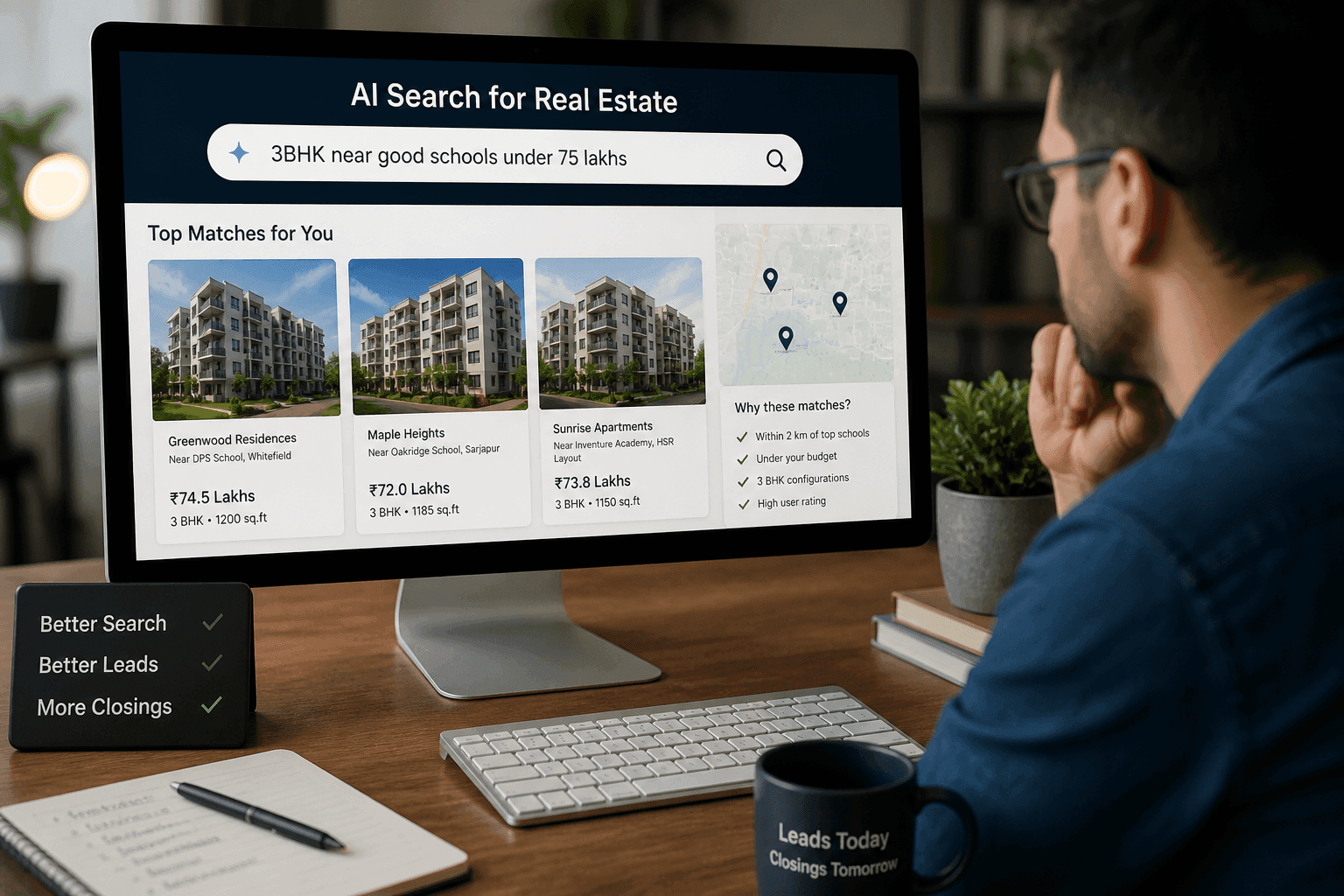
Imagine your website acting as a digital pre-sales agent that understands queries like "Any 3BHK available near good schools under 75L?" and guides the user accordingly. This is the power of an AI-powered semantic search layer.
Moving from 'Keyword Search' to 'Answer-First' Experiences
Instead of forcing users to browse through 20 listing pages, an "answer-first" approach provides the direct answer and the source. If a user asks, "What are the average prices for 2-bedroom apartments in the city center?" the site should provide the answer immediately, followed by a clickable link to the relevant listings. This builds immediate trust and reduces user effort.
Handling Natural Language Queries
Real estate queries are often vague, multilayered, and emotionally driven. A semantic search engine can handle these naturally. Instead of using rigid filters, users can search with questions like "Which areas in Mumbai are best for investment under 1 crore?" When your website answers these naturally, users stay longer and are far more likely to convert.
Reducing Support Tickets through Instant Self-Serve Answers
By providing instant, accurate answers to common questions about financing, closing costs, or neighborhood details, you deflect repetitive inquiries. This allows your human agents to focus on high-value, qualified leads rather than answering the same question about parking spaces ten times a day.
Optimizing Your Site for Maximum Lead Capture
To maximize your lead generation, map your content to the Buyer's Journey:
- Awareness: Provide hyper-local guides and market reports. 2n. Consideration: Provide comparison tools and neighborhood deep-dives.
- Decision: Provide instant answers to specific property questions and seamless lead capture.
Using Search Intelligence to Identify Content Gaps
Every search is a data point. By using Content Intelligence, you can understand user demand on-site and see exactly what local buyers are searching for but not finding. For instance, if 50 people search for "pet-friendly rentals in the East Side" and you have no results, you know exactly what listings or content you need to add to capture those leads.
Integrating Seamless Lead Capture within Search Results
Rather than a generic "Contact Us" form, integrate lead capture within the search experience. When a user finds the answer they need, offer a complementary action: "Found the answer? Now schedule a tour of these three properties." This bridges the gap between browsing and enquiry.
Measuring the ROI of Your Lead Generation Engine
Key Metrics: Beyond the Lead Count to Lead Quality
Don't just track the lead count. Track the lead quality. A lead who has searched for specific budget, location, and school preferences is a more qualified lead than someone who just downloaded a generic PDF.
Analyzing Search Intent to Refine Your Offer
Use your search data to analyze the intent of your visitors. Are they looking for investment properties or first-time homebuyer guides? This allows you to refine your offer and your marketing strategy to match the actual demand of your market.
Lead Generation Optimization Checklist
- Audit your search bar: Does it handle natural language queries or just keywords?
- Audit your content: Do you have hyper-local guides for the specific neighborhoods you serve?
- Optimize landing pages: Do your PPC ads lead to direct answers, not generic homepages?
- Analyze search data: Use search queries to identify content gaps in your listings?
- Implement an answer-first experience: Do users get immediate answers to their questions?
FAQ
What are the most effective online lead generation strategies for real estate in the current market?
Effective strategies include a combination of hyper-local SEO, high-intent PPC, and video content to build trust. However, the most critical part is optimizing the discovery phase on your site so that users can find answers instantly without friction.
Why do many real estate websites fail to convert high-quality traffic into leads?
Many sites fail because of the "conversion gap"—the friction caused by traditional keyword-based search and traditional filters. When users cannot find specific answers to their emotionally driven queries, they will bounce.
How does semantic search improve the user experience for home buyers and sellers?
Semantic search understands the intent behind a query, meaning it can handle natural language questions and provide "answer-first" responses. This allows users to find properties and information faster, and they are more likely to stay on your site longer.
How can real estate agents use search data to find out what their clients are actually looking for?
By analyzing the search queries users enter into your on-site search bar, you can identify content gaps. This allows you to identify exactly what buyers are looking for—such as specific amenities or school districts—and direct your listings and content strategy accordingly.
Experience how semantic search turns your website into a lead-generation machine—Try Seekrs today.