
The Future of Search Engines for Travel Sites
For most travel websites, the search bar is the primary conversion point. Yet, for many, it remains a rigid tool. When a traveler searches for a "family-friendly beach holiday in Greece," a traditional holiday search engine often relies on exact keyword matching. If the page isn't tagged with those specific words, the user sees "No results found," and the booking is lost.
Modern travelers don't search with keywords; they search with intent. The shift toward semantic search for websites is fundamentally changing how people discover destinations and how travel brands convert visitors into guests.
The Friction in Modern Holiday Search
Why keyword-matching fails the modern traveler
Traditional search engines on travel sites are built on a database of tags. If a user types "quiet getaway for couples," but your packages are labeled "romantic retreats," the system fails to connect the two. This creates a disconnect between how people actually speak and how data is stored.
The gap between user intent and search results
When a user searches for "best time to visit Japan," they aren't just looking for a list of hotels. They are seeking guidance. When a site provides a list of 50 hotels in Tokyo instead of answering the question, it creates decision fatigue. This gap between the user's intent (planning) and the result (a list of products) often leads to search abandonment.
What Defines a 'Smart' Holiday Search Engine?
To move beyond the basic holiday search engine, travel sites need a system that understands meaning, not just characters. This is where ai powered site search transforms the user experience.
Understanding natural language (NLP) in travel queries
Natural Language Processing (NLP) allows a search layer to understand that "somewhere warm in December" implies a specific set of geographic regions and climates. It interprets the meaning behind the query, surfacing the most relevant packages regardless of the exact wording used in the content.
Moving from rigid filters to intent-aware discovery
Instead of forcing users to click through ten different filters for price, star rating, and location, an intelligent system uses intent-aware suggestions. For example, if a user types "adventure trip for teens," the AI understands the intent is activity-based discovery and can immediately suggest hiking, rafting, or surfing packages.
The power of 'Answer-First' results for travel planning
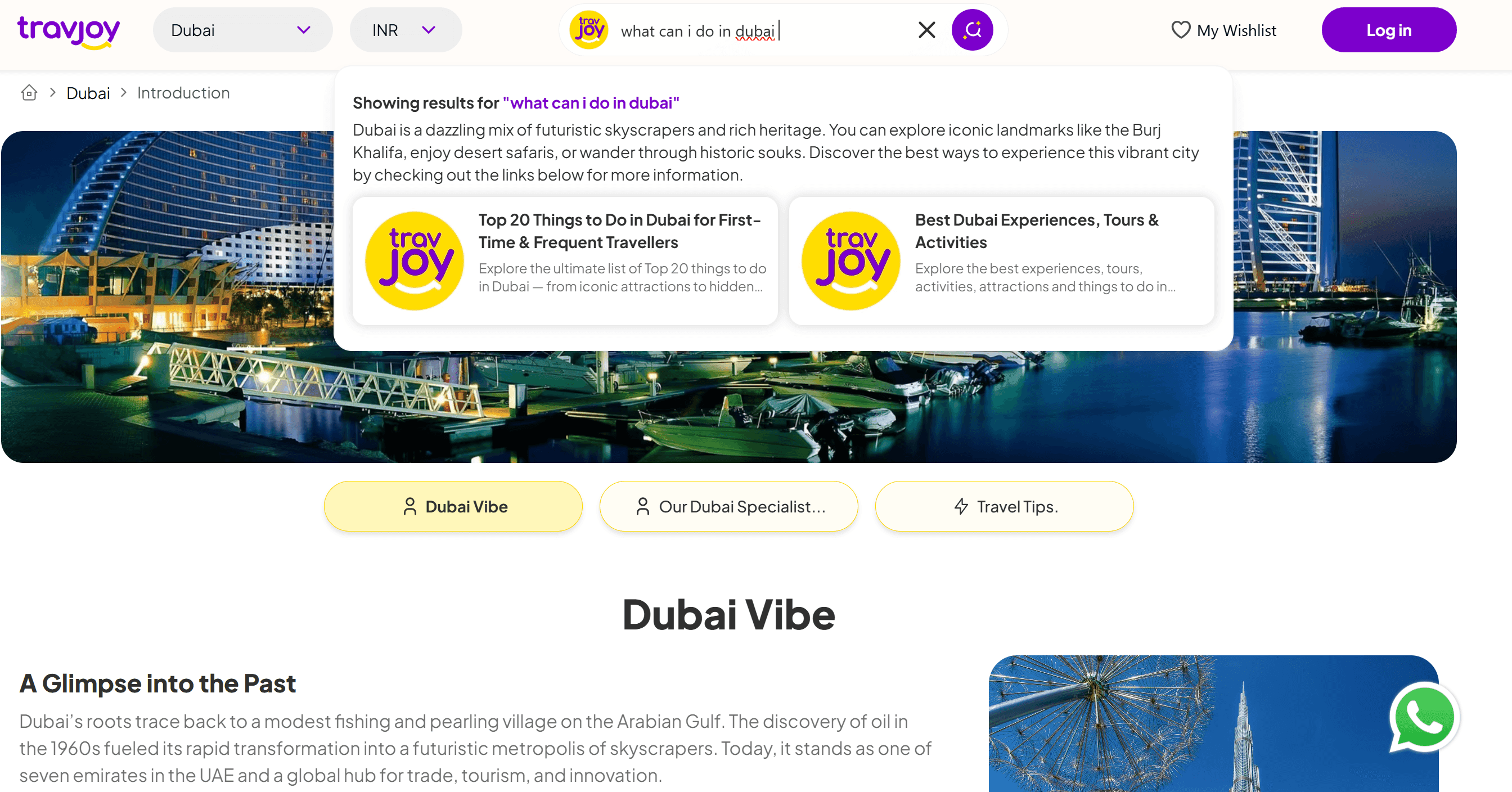
One of the biggest shifts in travel UX is the "Answer-First" approach. Instead of sending a user to a results page, the search engine provides a direct, concise answer based on your site's content, followed by clickable sources.
Example: If a user asks, "What can I do in Dubai?", the AI doesn't just list hotels. It responds: "Dubai offers world-class shopping at the Dubai Mall, the Burj Khalifa for views, and desert safaris for adventure. Here are the top 20 things to do in Dubai: [Link to Guide]." This turns the search bar into a travel companion rather than a simple filter.
How Semantic Search Drives Travel Conversions
Reducing bounce rates by eliminating 'No Results Found'
By understanding synonyms and context, semantic search ensures that users almost always find a relevant path forward. By eliminating the "dead end" of a zero-results page, you keep the user on your site longer and reduce the likelihood of them returning to Google to find a competitor.
Shortening the path from inspiration to booking
When a search engine can anticipate traveler preferences and suggest destinations before the user has fully articulated their needs, the path to booking is shortened. By reducing decision fatigue, the AI filters thousands of options into a few highly personalized recommendations, moving the user from the "dreaming" phase to the "booking" phase faster.
Using search data to identify content gaps in your holiday offerings
An intelligent site search provides more than just results; it provides content intelligence. By analyzing what users are searching for but not finding, travel brands can identify gaps in their offerings. For instance, if 500 people search for "sustainable glamping in Norway" and you don't have that content, you have a data-driven roadmap for your next product offering.
Implementing AI Search Without a Total Site Rebuild
Many travel agencies fear that upgrading their search requires a complete backend overhaul. However, the modern approach is to implement a semantic layer over existing databases.
Integrating a semantic layer over existing databases Seekrs acts as an AI-powered search and discovery layer that plugs into your existing site. For example, on TravJoy, Seekrs was implemented to support complex user journeys like destination discovery and intent-based exploration. This allows brands to offer advanced AI search on their website and even extend it to conversational environments like WhatsApp without changing their core database.
Maintaining transparency with clickable sources Trust is paramount in travel. Users need to know that the AI's suggestions are based on actual packages and policies. A smart search engine must always provide clickable sources and links to the original content, ensuring the user can verify the details and proceed to checkout with confidence.
Conclusion: The Competitive Edge of Intent-Based Discovery
The future of travel search is not about finding a document; it is about understanding a person. As search shifts from keywords to intent, travel brands that provide an "Answer-First" experience will become the trusted sources for travel planning. By turning your search bar into a travel companion, you reduce friction, eliminate decision fatigue, and increase conversions.
Travel Search Optimization Checklist
- Does your search bar handle natural language queries (e.g., "somewhere warm in January")?
- Do you provide direct answers to questions before listing product results?
- Do you have a way to track "zero-result" queries to identify content gaps?
- Are your search results backed by clickable, verifiable sources?
- Does your search experience remain consistent across web and mobile platforms?
FAQ
What is a holiday search engine in the context of a travel website? It is the internal search tool that allows visitors to find specific holiday packages, destinations, or travel guides on a travel site. While traditional versions rely on keyword matching, modern versions use AI to understand user intent.
Why is semantic search superior to keyword search for travel planning? Semantic search understands the meaning and context of the user's query. For example, it can connect "quiet getaway" with "romantic retreats," ensuring users find relevant results even if they don't use the exact words found on your pages.
How does an AI-powered search engine reduce customer support tickets for travel agencies? By providing "Answer-First" results, the AI can instantly answer common questions about visas, baggage policies, or destination activities, allowing users to find answers themselves rather than submitting a support ticket.
Can you add semantic search to an existing website without changing the backend? Yes. By implementing a semantic search layer, such as Seekrs, you can add AI-powered discovery and natural language understanding to your existing site and knowledge base without needing a total rebuild of your backend database.