
How AI-Powered Search Chatbots Are Transforming On-Site Discovery
User expectations have shifted. In an era of conversational AI, visitors no longer want to navigate nested menus or guess the exact keywords required to find a specific policy or product feature. They expect an immediate, accurate answer.
Forcing users to manually browse multiple pages for a simple answer is a significant friction point. When discovery is difficult, users bounce. To maintain engagement, businesses must move beyond the traditional search bar and implement an AI-powered semantic search layer that understands intent, not just keywords.
What is an AI Powered Search Engine?
An ai powered search engine uses machine learning and Natural Language Processing (NLP) to understand the meaning behind a query rather than simply matching characters in a string.
From Keyword Matching to Intent Understanding
Traditional search relies on "keyword matching." If a user searches for "shipping costs," the system looks for pages containing those exact words. If your documentation uses the term "delivery fees," the system may return "No results found," even though the meaning is identical.
An AI-powered engine shifts the focus to user intent. It recognizes that "shipping costs" and "delivery fees" are semantically the same, ensuring the user finds the right answer regardless of how they phrase the request.
The Role of NLP in Modern Search
NLP allows a search engine to parse human language as it is actually spoken. Instead of a fragmented query like "return policy," a user might ask, "Can I return a product if I opened the package?" NLP identifies the core intent (returns) and the entity (opened product) to retrieve the most relevant policy.
Web Search vs. Site Search: The Critical Difference
It is common to confuse general AI tools with dedicated on-site search solutions. However, their goals and data sources are fundamentally different.
General AI Search (The 'Answer' Engines)
Tools like Perplexity or Gemini crawl the entire web to provide broad answers based on massive, general datasets. While powerful, they lack the specific, real-time context of your internal documentation, pricing, or unique product nuances.
On-Site AI Search (The 'Discovery' Layer)
On-site AI search, such as Seekrs, is a specialised layer that sits on top of your existing content. It doesn't guess based on the general web; it uses your specific website data to provide accurate, brand-specific answers. This transforms your website into a conversational knowledge hub where the AI acts as a domain expert for your visitors.
The Risk of General AI Tools
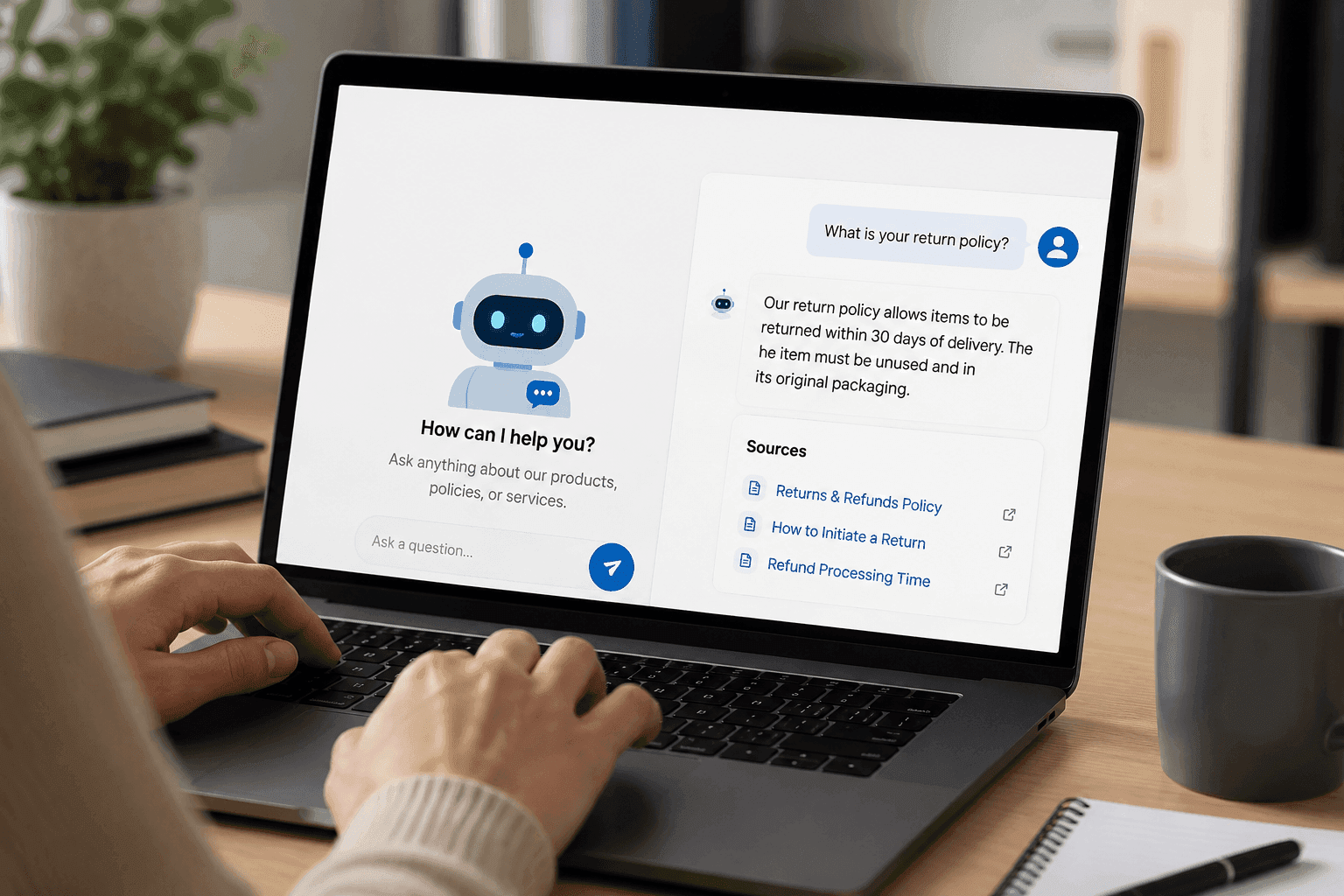
Integrating a general-purpose chatbot not grounded in your site data leads to "hallucinations"—where the AI invents answers. For B2B companies, this is a liability. You need a system that provides source transparency, showing the user exactly which page or document the answer was derived from to maintain trust.
Why Traditional Website Search Fails Visitors
Most traditional search bars are essentially basic filters. They create friction by forcing the user to adapt to the machine's logic.
The 'No Results Found' Dead End Nothing kills a conversion faster than a "No results found" message. This usually happens when a user's terminology differs from the website owner's. For example, a user searching for "payment methods" might see no results if the site only uses the term "billing options."
The Friction of Perfect Keywords Users search as they think. They don't know your internal jargon or how you've organised your folders. Forcing them to guess the "perfect" keyword is a barrier to entry. An AI-powered search engine removes this friction, allowing users to find answers naturally without needing to learn your site's architecture.
How Semantic Search Solves the Discovery Problem
Semantic search uses vector technology to map words and concepts into a mathematical space where similar meanings are grouped. This creates a more human-like discovery experience.
Understanding Meaning, Not Just Words
By focusing on meaning, the search engine can handle ambiguous queries. If a user asks for "something to help with my back pain," the system can suggest products related to ergonomics or lumbar support, even if the word "back pain" isn't explicitly mentioned on every product page.
Answer-First Results: Reducing Time-to-Value
Traditional search provides a list of links. AI-powered search utilises an answer-first UI. Instead of clicking through three different pages to find a specific date or price, the AI delivers the answer directly in the search interface, with clickable sources for verification. This drastically reduces the time-to-value for the user.
Turning Documentation into a Self-Serve Experience
For companies with extensive help centers, the goal is to turn documentation into a self-serve experience. Instead of a user reading through a 20-page manual, the AI chatbot explains the specific step they need, citing the exact section of the documentation. This turns a static resource into an active assistant.
Business Impact: Who Benefits from AI Site Search?
Implementing an intelligent search layer provides measurable outcomes across different teams.
Growth & Marketing: Reducing Bounce Rates
When users can't find what they need, they bounce. By providing instant answers, you improve user journeys with better discovery, ensuring that visitors stay on your site and move closer to a conversion point.
Customer Support: Deflecting Repetitive Tickets
Support teams are often overwhelmed by the same five to ten questions. An AI search engine can deflect these repetitive tickets—such as "How do I reset my password?" or "Where is the API key?"—by providing accurate, instant answers, allowing agents to focus on complex, high-value problems.
Content Teams: Identifying Content Gaps
One of the most powerful aspects of AI search is content intelligence. By analysing what users are searching for—and where they encounter "no results"—content teams can identify exactly where the website is missing information. This allows them to create content that meets actual user demand rather than guessing.
Choosing the Right AI Search Layer for Your Business
Avoid the hype and focus on practical outcomes.
Integration Ease vs. Custom Build: Building a custom AI search engine from scratch is resource-heavy. For most businesses, a plug-and-play semantic search layer is more efficient. Look for a solution that integrates with your existing site and knowledge base with minimal disruption.
The Importance of Source Transparency: To avoid hallucinations, ensure your tool provides clear citations. Trust is built through transparency. Your users should always know where the answer came from, which is why source-backed answers are non-negotiable.
Summary Checklist for AI Search Implementation
- Audit your current search failures: Analyse your "no results" queries to see where users are getting stuck.
- Define your discovery goals: Are you trying to reduce support tickets or increase product discovery?
- Prioritize source transparency: Ensure the AI provides links to the original content for verification.
- Evaluate integration ease: Choose a tool that allows you to plug into your existing content without a total rebuild.
FAQ
What is the difference between a traditional search engine and an AI-powered one?
Traditional search engines rely on keyword matching, meaning they look for exact words. AI-powered search engines use semantic search to understand the intent and meaning behind a query, providing more accurate results even if the exact words aren't used.
How does semantic search differ from keyword search?
Keyword search looks for specific strings of text. Semantic search understands the context and the relationship between words, allowing it to handle synonyms and natural language queries more effectively.
Can an AI search engine help reduce customer support tickets?
Yes. By providing instant, accurate answers to common questions directly from your documentation, an AI search engine can deflect repetitive tickets, allowing users to find answers themselves.
Why is 'intent' more important than 'keywords' in modern search?
Intent is the core of what the user actually wants to find. Keywords are just the way they express it. By focusing on intent, a website can understand the user's goal regardless of how they phrase their query.
How do I implement AI search on my existing website without a total rebuild?
You can implement an AI-powered semantic search layer that plugs into your existing site and knowledge base, allowing you to add intelligent discovery without needing to change your entire website architecture.