
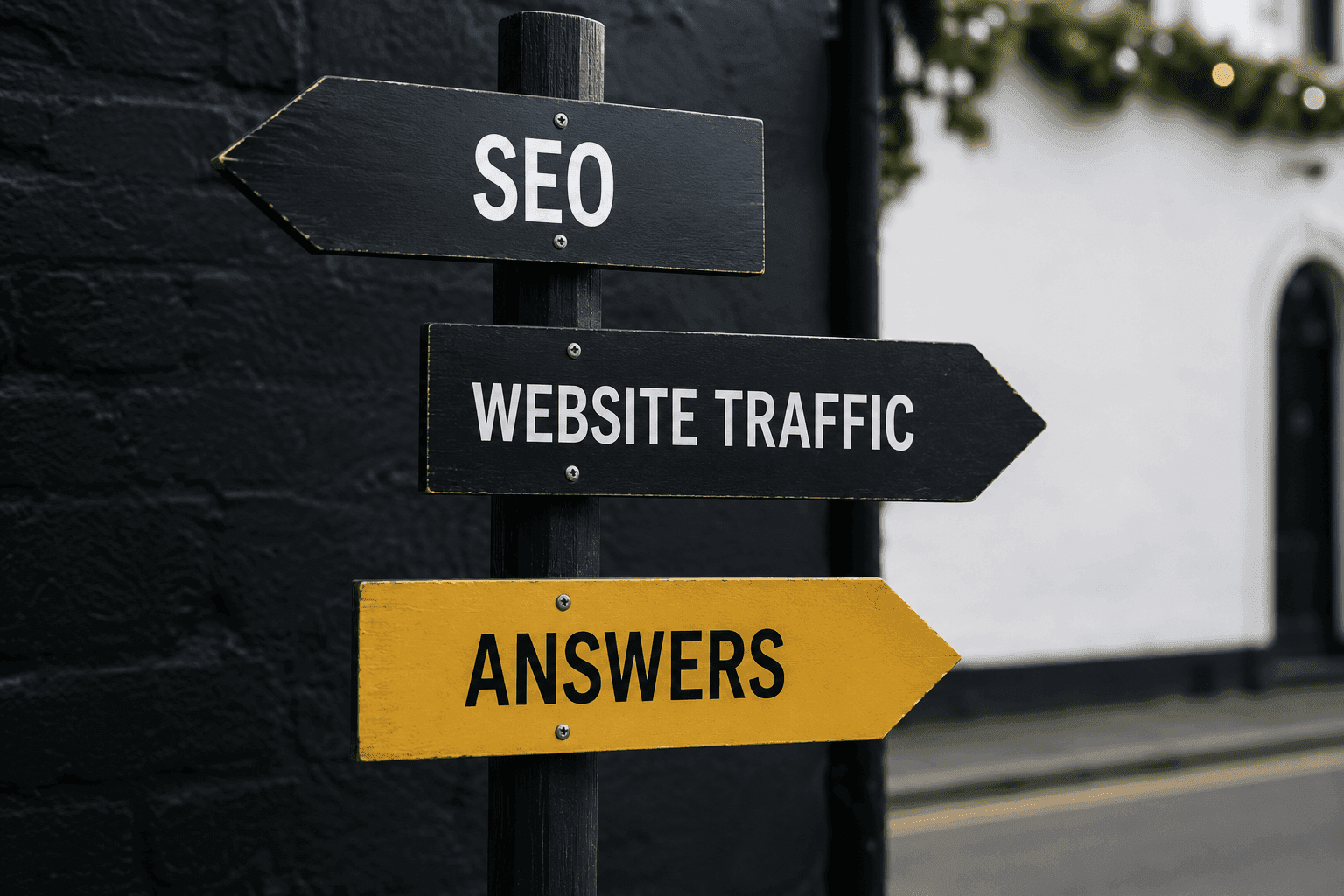
The Last Mile of SEO: Turning Search Traffic into Actual Answers
Ranking on page one is a significant achievement, but it is only half the battle. Many B2B companies invest heavily in a website SEO service to drive traffic, yet their bounce rates remain stubbornly high. The reason is simple: ranking attracts the visitor, but the ability to find a specific answer is what keeps them there.
This is the "last mile" of SEO. While traditional SEO focuses on the click, the last mile is about satisfying user intent the moment they arrive. If a visitor lands on your site and cannot immediately find the answer they need, they will hit the back button—regardless of how high you ranked.
The Paradox of Modern SEO: More Traffic, Same Bounce Rates
Ranking is only half the battle! Traditional SEO metrics often treat the click as the ultimate conversion. However, traffic is a vanity metric if it doesn't lead to a solved problem. When a user clicks through from Google, they aren't just looking for a page; they are looking for a solution to a specific pain point.
Most companies don't have a content problem; they have an information-retrieval problem. The information users need is often already on the site, but it is fragmented across documentation, blog posts, and FAQs. When users are forced to navigate complex menus or use a rigid site search that only matches exact keywords, they experience friction. This friction is where you lose potential customers.
What a Comprehensive Website SEO Service Should Actually Cover
To maximize ROI, a website SEO service must move beyond the basics. While the traditional pillars are essential, they are no longer sufficient for the modern B2B buyer.
Traditional pillars: Technical SEO, Content, and Authority
Most strategies focus on these three areas:
- Technical SEO: Ensuring the site is crawlable and fast.
- Content: Creating high-quality, keyword-optimized pages.
- Authority: Building backlinks to improve trust and domain rating.
The missing pillar: On-site discovery and intent-aware search
To close the gap between traffic and conversion, businesses need to integrate semantic search for websites. This transforms a collection of static pages into a searchable knowledge base. Instead of forcing users to navigate a hierarchy, you provide a direct path to the answer. On-site answer retrieval should be treated as a core part of SEO performance, not just a UX detail.
Keyword Matching vs. Semantic Understanding
Traditional site search is lexical. It looks for exact word matches. For example, if a user searches for “how to reset my account password” but your page is titled “Account Access and Security Guide,” a basic search might fail or return irrelevant results. This leads to the “No results found” page—the ultimate dead end for a user journey.
Unlike lexical search, ai powered site search uses Natural Language Processing (NLP) to understand the underlying intent. It recognizes that "integrate" and "connection" are related concepts. It interprets the user's task rather than just matching strings of text. This allows the site to provide the most relevant page or a direct answer, even if the user doesn't use the exact terminology your team used when writing the content.
By moving from lexical matching to intent resolution, you eliminate dead ends. When users find answers instantly, they stay longer and their trust in your brand increases. The experience becomes a continuous flow from the external search engine to the internal site experience.
How Intelligent Site Search Multiplies Your SEO ROI
Improving dwell time and reducing bounce rates
When a user finds what they need quickly, dwell time increases and bounce rates drop. Search engines notice this behavior, which signals that your site is a high-quality destination, further boosting your seo website strategy.
Using search intelligence to identify content gaps
An intelligent site search layer acts as a continuous "voice of the customer" system. By analyzing what people search for—and what they cannot find—you gain real-time data on content gaps. For instance, if you see a spike in queries like "enterprise SSO setup" but have no dedicated page for it, you know exactly what to write next based on actual demand rather than guessing with keyword tools.
Turning documentation into conversion engines
For B2B and SaaS companies, the help center is often a primary conversion point. When users can find answers to technical questions—such as "how to set up API webhooks"—instantly, they move from the consideration phase to the decision phase faster. This turns your documentation into a self-serve engine that drives revenue rather than a support burden.
Evaluating Your SEO Strategy for 2026
Questions to ask your SEO provider
If you are working with a website SEO service, ask these questions to ensure they are focusing on the last mile:
- Do we have a strategy for what happens after the user clicks?
- How are we measuring the success of our on-site discovery experience?
- How are we using on-site search data to inform our content roadmap?
- Is our site search capable of understanding user intent, not just keywords?
Moving from 'Traffic Growth' to 'Answer Accuracy'
The goal of SEO in 2026 should not be just to grow traffic, but to increase answer accuracy. When you prioritize the ability of your users to find answers, you stop losing visitors to poor discovery. Implement a semantic search layer with Seekrs to help your users find answers instantly.
FAQ
Q: What is a website SEO service and what are its core components?
A: A website SEO service typically includes technical optimization, content creation, and authority building. However, a modern service should also focus on on-site discovery to ensure users can find answers once they arrive.
Q: Why is ranking high in Google not enough to guarantee conversions?
A: Ranking attracts traffic, but if users cannot find the specific information they need quickly, they will bounce. Conversions happen when user intent is satisfied, not just when a page is loaded.
Q: What is the difference between traditional site search and traditional semantic search?
A: Traditional search uses exact word matching (lexical search), while semantic search uses AI and NLP to understand the meaning and intent behind a query, providing more accurate results even without perfect keywords.
Q: How does AI-powered search help reduce customer support tickets?
A: By turning documentation and FAQs into a self-serve experience, users can find accurate answers instantly, deflecting repetitive tickets that would otherwise go to your support team.
Q: How can on-site search data inform a better content strategy?
A: On-site search data reveals exactly what your visitors are looking for and where they find gaps in your content. This allows you to create content that addresses real user demand based on actual search intent data.