Increase Website Conversions by Improving User Discovery
Most businesses treat website conversion optimization (CRO) as a game of pixels. They A/B test button colors, tweak headline phrasing, and shift lead forms a few inches to the left. While these surface-level changes can provide marginal gains, they often ignore the most critical leak in the funnel: the discovery gap.
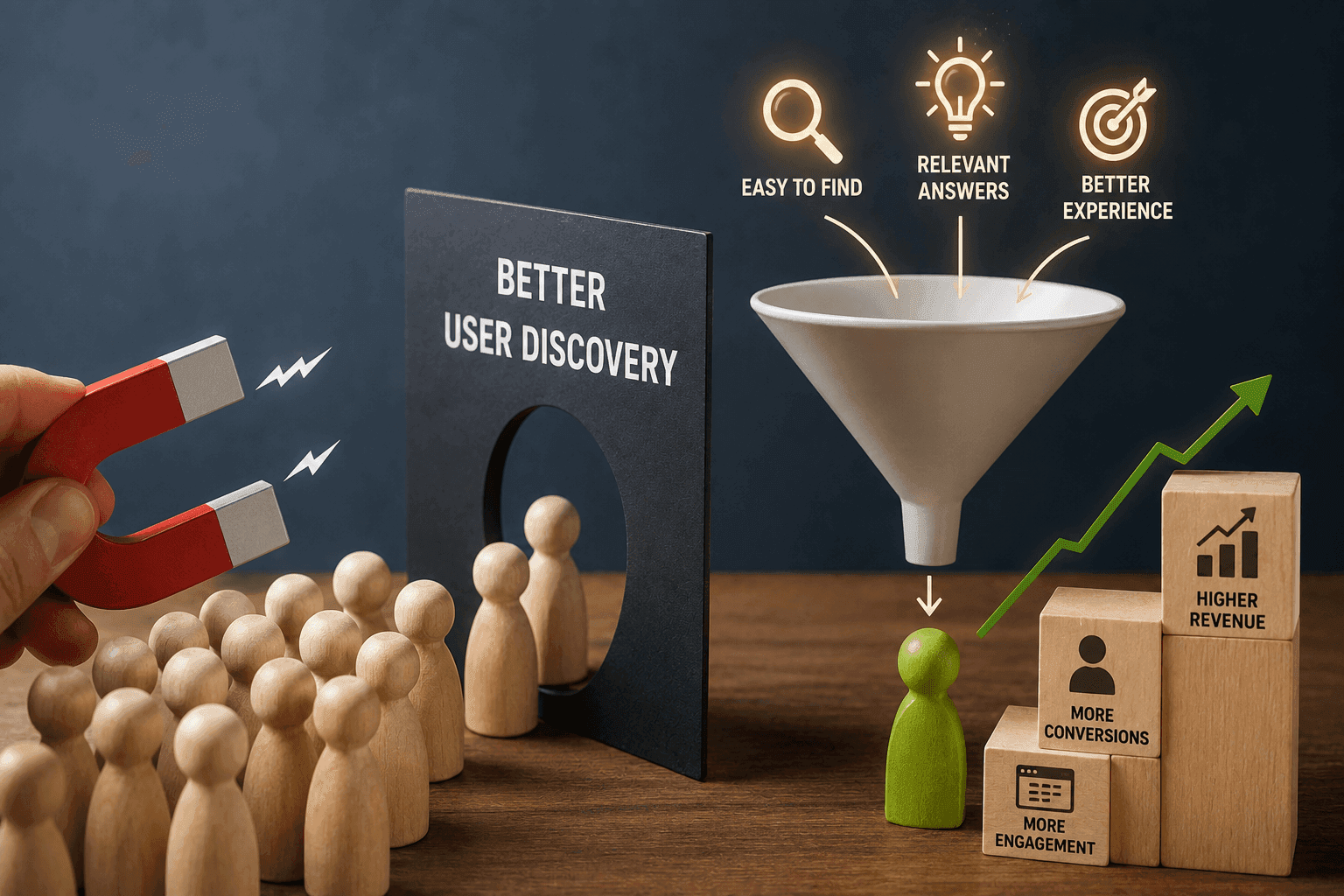
If a visitor arrives with a specific question—like "Does this integrate with my existing CRM?"—and cannot find the answer within seconds, they won't wait for a better button color to guide them. They will leave. To truly increase conversions, you must shift your focus from tweaking buttons to solving discovery.
What is Website Conversion Optimization (CRO)?
Website conversion optimization is the process of increasing the percentage of visitors who take a desired action, such as signing up for a trial, purchasing a product, or downloading a whitepaper.
Conversion is no longer a linear path. Users don't just land on a homepage and click "Buy Now." They explore documentation, compare features, and search for specific integrations. A conversion happens when a user's intent is matched with the right piece of content at the exact moment they need it.
Traffic brings people to the door, and User Experience (UX) ensures the door is easy to open. However, conversion is the result of the user feeling confident enough to move forward. When a user encounters friction—such as a confusing navigation menu or a search bar that returns "No results found"—that confidence evaporates. High-quality traffic is wasted if the discovery process is broken.
The Hidden Conversion Killer: The Discovery Gap
The discovery gap is the space between what a user is thinking and what your website is capable of returning. This is where most conversions are lost.
Why "No Results Found" is a Bounce Trigger There is nothing more discouraging to a potential customer than a search result page that says "No results found." It is a digital dead end. When users see this, they perceive your product as lacking the feature or answer they need, even if the information exists elsewhere on your site. This leads to an immediate bounce, killing the conversion opportunity.
Keyword Matching vs. Intent Understanding Traditional site search relies on keyword matching. If a user searches for “Can I use this with Salesforce?” but your website uses the term “CRM compatibility,” the search might fail. This is a fundamental flaw. Users describe their needs in natural language, while websites often label content using technical terminology.
By implementing a semantic search layer, your website can understand the meaning behind the query, not just the words. This bridges the discovery gap by connecting user intent with the most relevant result, regardless of the exact phrasing.
How Friction in Information Retrieval Stalls the Funnel Every second a user spends hunting for an answer is a second they spend questioning whether your solution is the right fit. Friction in information retrieval creates cognitive load. When discovery is effortless, the path to conversion is cleared of obstacles.
High-Impact Strategies for Website Conversion Optimization
To move beyond surface-level CRO, you need a strategy that addresses the discovery process and the overall user journey.
Your value proposition should be immediate. Visitors should know exactly what you do and who you do it for within seconds of landing. This reduces initial friction and sets the stage for the discovery process.
One of the most effective ways to reduce cognitive load is to replace traditional search with AI-powered search tools. Instead of forcing users to guess the "right" keywords, semantic discovery allows them to search naturally. This transforms the search bar from a utility into a digital salesperson, guiding users toward the product or answer they are most likely to need.
Trust is the currency of conversion. Integrate testimonials, case studies, and security certifications near your primary CTAs. When users can find these trust signals quickly, their objections are lowered and the likelihood of conversion increases.
While button colors matter, the context of the CTA is more important. Ensure your CTAs are placed where the user has just received the value they were looking for. For example, if a user finds an answer to a complex technical question via search, the CTA to "Start a Free Trial" should be immediately adjacent to that answer.
Using Search Intelligence to Drive CRO
Search data is the most honest feedback loop you have. While heatmaps show you where people click, search queries show you exactly what they want.
Identifying Content Gaps Through User Search Intent
When users search for terms that return no results or result in a bounce, you have a goldmine of data. These are your content gaps. By analyzing search intent, you can identify exactly what information is missing from your site, allowing you to create content that directly addresses user objections.
Turning Search Queries into Conversion Opportunities
Search queries are high-intent signals. A user searching for "pricing for 100 users" or "enterprise security compliance" is much closer to converting than someone browsing the homepage. By providing instant, precise answers to these queries, you can accelerate the move from discovery to action.
The Role of Instant Answers in Reducing Support Tickets
When users find answers instantly, they don't need to submit a support ticket. This not only reduces the burden on your support team but also keeps the user in the conversion flow without the interruption of waiting for an email response. Self-serve discovery is a conversion engine.
Measuring CRO Success: Metrics That Actually Matter
To measure the success of your conversion optimization efforts, look beyond the basic conversion rate.
Track the "Search-to-Conversion" path. What percentage of users who interact with the search bar convert at a higher rate than those who don't? If you improve the discovery process, you should see a lift in the conversion rate of users who successfully find what they are looking for.
Bounce rate is a metric of initial failure. Exit rate is a metric of engagement. If your search results page is a high-exit page, it means users are encountering dead ends. Focus on reducing the bounce rate of your search results page to improve overall site conversion.
CRO Implementation Checklist
Use this checklist to ensure your discovery-led approach to website conversion optimization is comprehensive:
- Audit your search logs: Identify the top 10 most common queries that return zero results.
- Crawl your site for friction: Perform a user journey mapping exercise to identify where users get stuck.
- Implement semantic search: Replace keyword-matching search with an intent-aware system.
- Crawl your documentation: Ensure your help articles and product pages are structured for easy discovery.
- Optimize CTAs: Place CTAs in context of the found answer.
- Review trust signals: Ensure testimonials and case studies are easily discoverable.
FAQ
What is the most effective way to increase website conversion rates?
The most effective way to increase conversions is to solve the discovery gap. Instead of focusing only on surface-level design changes, ensure that visitors can find the exact answers to their objections and the products they need without friction.
How does site search impact the overall conversion rate?
Site search is often the highest-intent signal on your website. When search fails, users bounce. When search works—by understanding intent and meaning—it guides users directly to the conversion point, significantly increasing the likelihood of a lead or sale.
What is the difference between traditional CRO and discovery-led optimization?
Traditional CRO often focuses on "tweaking buttons" and landing page design. Discovery-led optimization focuses on the structural ability of the user to find information. It solves the discovery gap by the ensuring the user's intent is matched with the most relevant content.
How do I identify where users are dropping off in my conversion funnel?
Analyze your search logs and bounce rates on search results pages. If users are "searching and bouncing," they are encountering a discovery gap. This is the discovery-led approach to identifying funnel leaks.
Stop losing leads to poor discovery—implement a semantic search layer with Seekrs to help your visitors find answers and convert faster.