
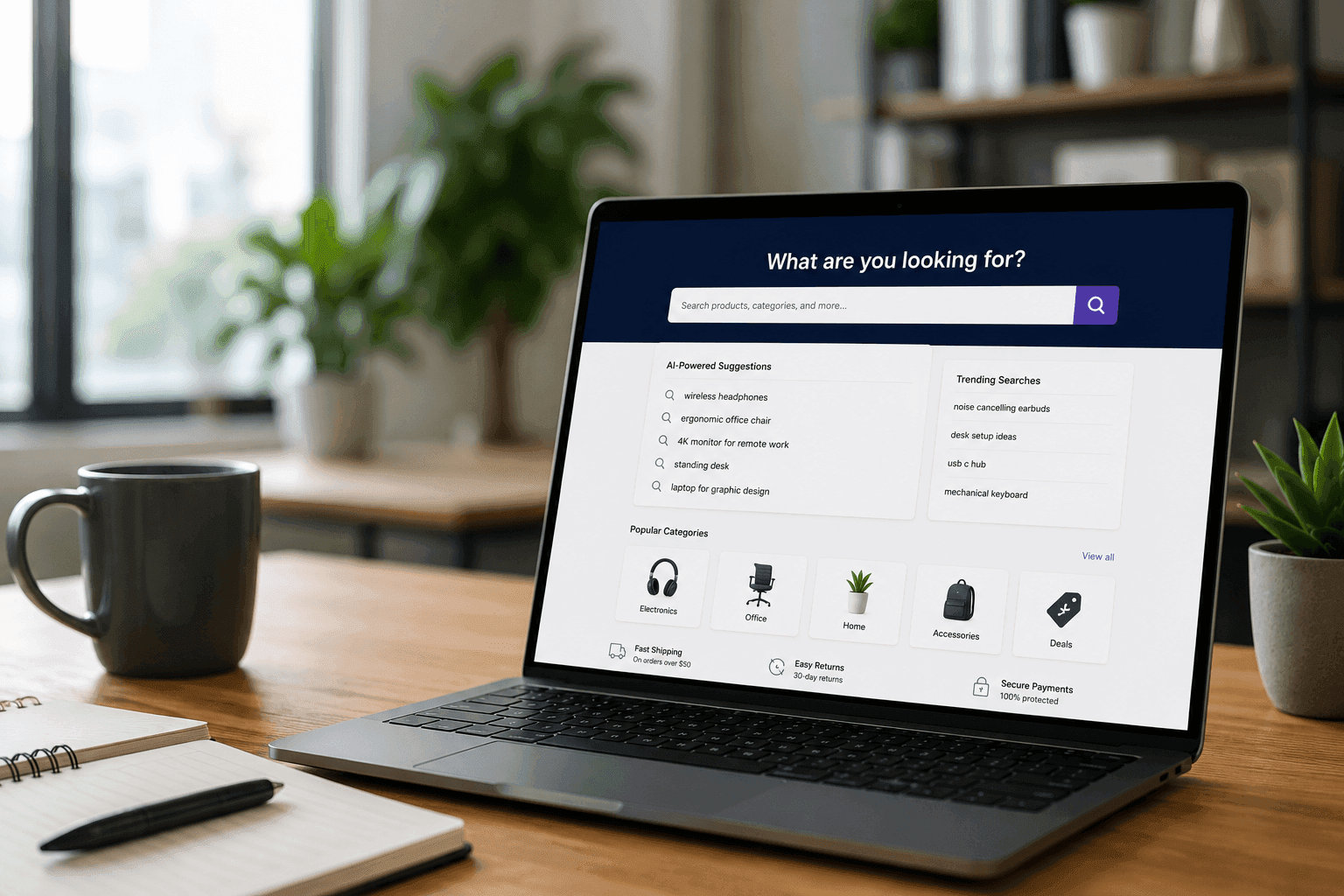
The Business Guide to AI-Powered Website Search: Turn Discovery into Conversion
Driving traffic to your website is only half the battle. You can invest heavily in SEO and marketing, but if visitors can't find the right information once they arrive, that investment is wasted. The gap between a visitor landing on your page and finding a solution is where most conversions are lost.
For many B2B companies, the solution isn't more content—it's a better way to find it. An AI-powered semantic search layer transforms the user experience from a frustrating keyword hunt into a seamless journey toward a conversion.
The Problem with Traditional Website Search
The 'Keyword Trap'
Traditional search bars act like digital filing cabinets; they look for exact word matches. If a user searches for "luxury apartment" but your page is titled "High-End Residential Units," the system may return zero results. This is the 'keyword trap'—the system lacks the context to understand meaning.
When users see "No results found," they don't assume your site is missing a page; they assume your business lacks the solution. They bounce, and you lose a lead.
The Cost of Friction
Every time a user fails to find an answer, they either dig through complex navigation or contact support. Most simply leave. For those who stay, the result is an influx of repetitive support tickets. Your team spends hours answering the same five questions because your search bar cannot guide users to existing documentation.
What is an AI-Powered Website Search Tool?
An ai powered website search tool is an intelligence layer that sits on top of your existing content. Using Natural Language Processing (NLP), it understands the context and intent of a query rather than just matching strings of text.
Semantic Search vs. Keyword Matching
While keyword search looks for the word "apple" and finds every page containing it, semantic search understands that a user searching for "something to eat" might be looking for fruit or a restaurant. It recognizes synonyms, context, and the relationship between concepts.
Understanding User Intent
By focusing on intent, AI search handles natural language queries effortlessly. For example, instead of typing "Shopify integration steps," a user might ask, "How do I integrate with Shopify?" The AI identifies the goal (integration) and the platform (Shopify) and delivers the most relevant page, regardless of the exact wording in your headings.
The 'Answer-First' Experience
Modern users expect an experience similar to AI assistants. They don't want to click through five pages to piece together an answer. An "answer-first" approach provides a direct, concise response generated from your site's content, followed by clickable sources. This ensures the user gets an immediate answer while maintaining trust through transparency.
Practical Applications Across Industries
Depending on your business model, an AI search solution can solve different operational pain points.
AI Search for Ecommerce
In ecommerce, users often search by need rather than product name. A shopper searching for "best shoes for wide feet" or "winter gear for a rainy city" is looking for a solution. A semantic search tool matches these descriptors to product features, reducing zero-result pages and increasing conversion rates.
AI Search for Real Estate
Real estate queries are often complex. A user might search for "quiet neighborhood with a big backyard for a dog" rather than just filtering by "3 bedrooms, 2 baths." AI search interprets this intent and surfaces the most relevant properties based on the full content of the site.
AI Search for Service-Based Businesses
Service businesses often have complex offerings that users find overwhelming. Instead of forcing users to guess which service page to read, an AI search tool guides them to the exact section of a page that addresses their specific pain point.
Turning Documentation into a Self-Serve Knowledge Base
For product teams, the biggest win is the ability to turn documentation into a self-serve experience. By allowing users to find precise answers within long-form docs, you deflect repetitive tickets and empower users to solve problems independently.
The Strategic Advantage: Content Intelligence
One of the most overlooked benefits of AI search is the data it provides. When visitors search on your website, they are telling you exactly what they are looking for in their own words.
Identifying Content Gaps
Search analytics expose customer pain points. If you see a high volume of searches for "refund policy for international orders" but the results are weak, you know exactly what content to create. You aren't guessing; you are using real on-site discovery data to drive your content strategy.
Using On-Site Intent to Drive Product Roadmap
Beyond content, these insights inform your product roadmap. If users are consistently searching for a feature that doesn't exist—such as "automated tax reporting for EU markets"—that search data becomes a primary signal for your product team to develop capabilities the market is actually demanding.
How to Implement AI Search Without Disrupting Your Site
Implementing a semantic search layer doesn't require a full site rebuild. It is designed to plug into your existing knowledge base.
Integration and Trust
Most modern AI search tools are designed as a layer that indexes your content and provides a search interface. This means you can improve user journeys with better discovery without changing your CMS or migrating data.
To avoid the "magic AI" problem—where AI generates answers that aren't based on facts—it is critical to use a tool that provides cited sources. By linking the generated answer directly to the page where the information was found, you maintain credibility and ensure the user can verify the information instantly.
Implementation Checklist for AI Search
- Audit your current search: Identify how many "no results found" pages are being triggered.
- Identify key user queries: Look at your search logs for common natural language questions.
- Define success metrics: Measure success by ticket deflection, increased conversion, or reduced bounce rates.
- Identify content sources: Ensure your help docs, product pages, and blog posts are all indexed.
- Verify source attribution: Ensure the tool provides clear links to the original content for every answer.
FAQ
What is the difference between semantic search and traditional keyword search? Semantic search understands the meaning and intent behind a query, whereas traditional search looks for exact word matches. This allows it to find relevant results even if the user doesn't use the exact words on your page.
How does an AI search tool reduce the load on customer support teams? By providing instant, answer-first responses derived from your documentation, users can find the exact answer they need without submitting a support ticket.
Can AI search help identify what content is missing from a website? Yes. By analyzing search queries that return poor results or zero results, businesses can identify content gaps and understand exactly what users are looking for.
How does AI search handle natural language queries? It uses Natural Language Processing (NLP) to understand the context of a full question, such as "How do I integrate with Shopify?" and matches it to the most relevant content based on intent.
Why are cited sources important in AI-generated search answers? Cited sources prevent AI hallucinations and maintain trust. They allow users to verify the information by clicking through to the original page on your website.