Upgrade Your Site Search: From Keyword Matching to Semantic Understanding
When visitors land on your website, they often have a specific need—whether it’s finding a product, troubleshooting an issue, or exploring your content. But if your website search engine only matches exact keywords, it can leave them frustrated and bouncing away. Traditional keyword-based search fails to grasp intent, meaning visitors might see zero results or irrelevant pages, even when your site has the answer. This isn’t just a minor inconvenience; it directly impacts user experience (UX), conversions, and support tickets.
At Seekrs, we’ve rethought on-site search. Instead of relying on rigid keyword matching, our AI-powered semantic search layer understands what people mean. It interprets natural language queries—like “How do I integrate with Shopify?”—and surfaces the most relevant pages, docs, FAQs, or products instantly, complete with source citations. This transforms your website from a static brochure into an intuitive, self-serve hub. In this guide, we’ll explore why semantic search is critical for modern websites, how it outperforms keyword-only systems, and how you can implement it with minimal effort.
The limits of keyword‑only site search
Keyword-only search engines operate on a simple premise: match the user’s query to words on your pages. But this approach is fundamentally flawed for human language, which is nuanced, contextual, and full of variations.
Why exact‑match fails visitors
Imagine a visitor typing “best laptop for college” into your site search. A keyword-only system might only return pages that contain the exact phrase “best laptop for college.” If your pages use synonyms like “top college laptops” or “ideal computers for students,” they won’t appear. This forces visitors to guess perfect keywords—a frustrating, trial‑and-error process that often leads to abandonment. According to Baymard Institute, poor site search contributes to high bounce rates, with 30% of e-commerce visitors using search and many leaving if results aren’t relevant.
Exact-match also ignores intent. A query like “return policy” could mean a user wants to initiate a return, understand timelines, or find contact info. Keyword search might dump all policy pages, making the visitor sift through information. This lack of understanding erodes trust and wastes time.
Common frustrations: zero‑results and irrelevant hits
Two major pain points plague traditional site search:
- Zero-results pages: When no exact keyword matches occur, users hit a dead end. For example, if someone searches “how to fix connection issues” but your page says “troubleshoot connectivity,” it won’t show up. Zero-results pages are a top reason for site exits.
- Irrelevant hits: Even when results appear, they might be off-target. A search for “budget templates” could return unrelated budgeting software if keywords overlap. This happens because the system doesn’t comprehend context or semantic relationships.
These issues aren’t just UX problems—they affect your bottom line. For growth teams, poor search means lost conversions; for support teams, it spikes ticket volumes; for content teams, it masks content gaps. Upgrading to a smarter intelligent site search is no longer optional; it’s essential for keeping visitors engaged and satisfied.
How semantic search changes the game
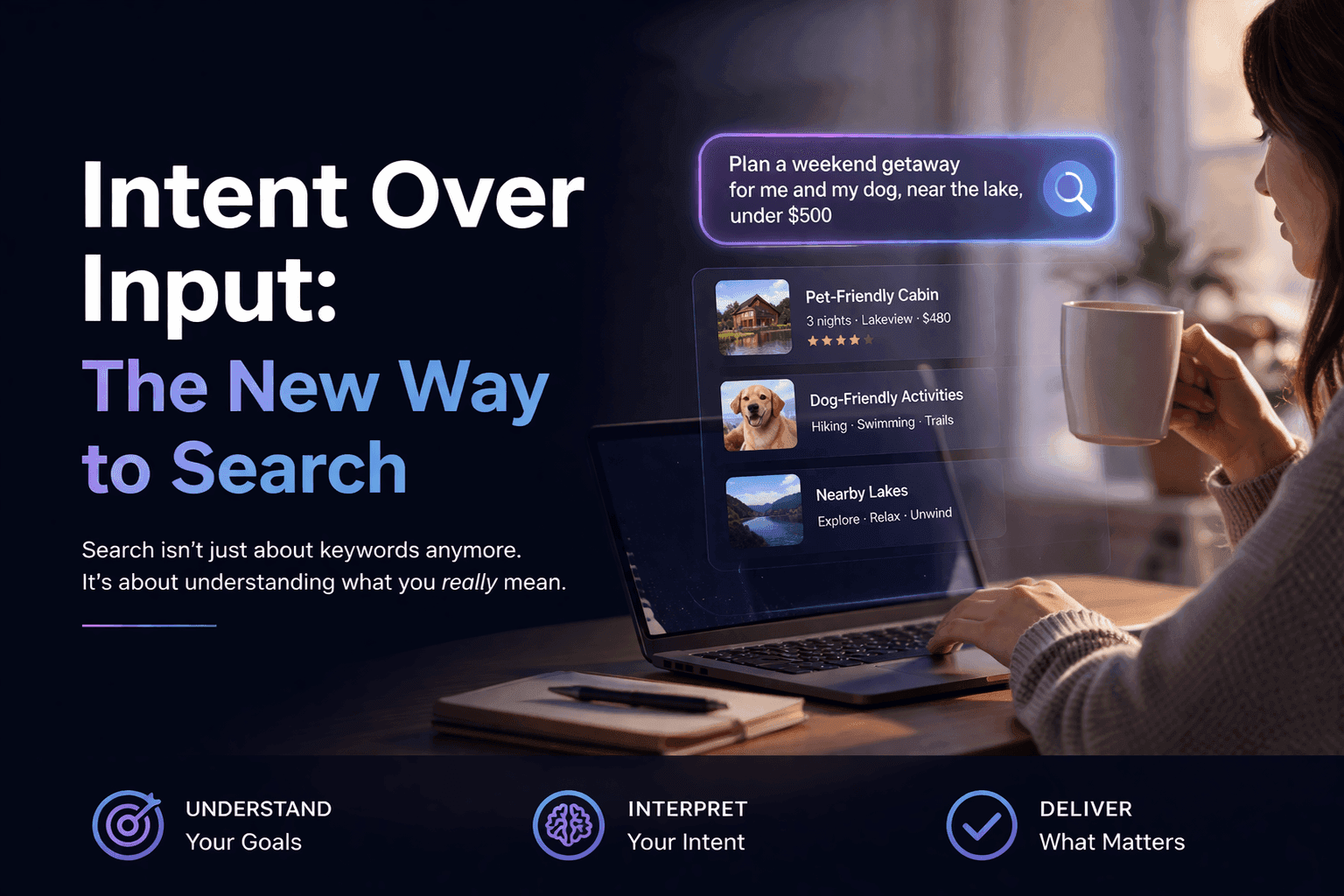
Semantic search uses AI and natural language processing (NLP) to interpret the meaning behind queries. It goes beyond word matching to understand context, synonyms, and user intent. This shift from keyword-centric to intent-first discovery revolutionizes how visitors interact with your site.
Understanding meaning, not just words
With semantic search for websites, the system analyzes the entire query and compares it to your content’s semantic embeddings—vectors that represent concepts and relationships. For instance, a search for “affordable running shoes” might match pages about “budget-friendly trainers” or “value running gear,” even if those exact terms aren’t used. This is possible because the AI grasps that “affordable” and “budget-friendly” are similar, and “running shoes” relate to “trainers.”
This approach handles complex, conversational queries. A user might ask, “I’m new to yoga—what mat should I buy?” A keyword搜 might miss this if your mat page doesn’t include “new to yoga.” But semantic search understands the intent: a beginner seeking recommendations. It can pull up introductory guides, beginner mats, and related articles, creating a seamless discovery journey.
Seekrs takes this further by being calmly confident—no hype, just reliable performance. We avoid “magic AI” language; instead, we focus on practical outcomes. As one customer noted, our product intelligently suggested relevant products based on user concerns, turning vague queries into actionable insights.
Instant answers with source citations
A key differentiator of Seekrs is our answer-first UI. When a query has a direct answer—like “What is your return policy?”—we provide an instant summary at the top, sourced from your official documentation. But unlike some AI tools, we always show source attribution. Users can click through to verify the answer, building trust through transparency. This isn’t just about speed; it’s about credibility.
For example, on a healthcare site, a search for “symptoms of flu” might display a concise answer pulled from a trusted article, with a link to the full page. Visitors get quick resolutions without sifting through results, yet they retain control to explore further. This balance of efficiency and openness reduces frustration and keeps users on your site longer.
Additionally, Seekrs offers intent-aware suggestions in autocomplete, guiding users toward better queries before they even hit search. This proactive help minimizes dead ends and improves discovery.
Adding Seekrs to your site in minutes
You might think upgrading to an AI-powered site search requires heavy development work. With Seekrs, it’s designed for minimal disruption. Our solution plugs into existing sites and knowledge bases quickly, regardless of your CMS or tech stack.
Lightweight integration steps
Integration is straightforward:
- Add a script snippet: Place a small JavaScript tag on your site, similar to installing analytics or chat widgets. No server-side changes needed.
- Crawl or import content: Seekrs automatically crawls your public pages or accepts a sitemap/API feed to index your content. This process takes minutes for most sites.
- Customize the widget: Use our dashboard to tweak the search UI—colors, placements, result layouts—to match your brand. You can also set up custom rankings or synonyms.
- Go live: Once indexed, the search is active. We handle updates continuously, so new content is searchable immediately.
There’s no need to overhaul your infrastructure. Whether you’re on WordPress, Shopify, or a static site, Seekrs works out of the box. This ease of use means your team can focus on content and growth, not technical headaches.
Measuring impact: time‑to‑answer and conversion lift
To justify the upgrade, track key metrics. Search analytics from Seekrs reveal:
- Time‑to‑answer: How long it takes users to find what they need. Semantic search should slash this by 50% or more.
- Zero‑result rate: Aim for under 5%. If it’s high, your content may have gaps Seekrs can highlight.
- Click‑through rate (CTR) on results: Higher CTR indicates relevant answers.
- Bounce rate reduction: Compare pages with vs. without search usage. Better search often lowers bounces.
- Conversion lift: For e-commerce, track if search users have higher add-to-cart or purchase rates.
One case study from Finnable.com showed that after adding AI-based search, they discovered users frequently searched for “login” and “customer service.” This content gap analysis prompted navigation improvements, reducing drop-offs significantly. By understanding on-site search intent, you can optimize not just the search box, but your entire site structure.
ROI is clear: reduced support tickets, higher engagement, and improved SEO as users spend more time on relevant pages. For growth teams, this translates to tangible business outcomes.
Conclusion: Make your website understand visitors
Your website search engine is a critical touchpoint. If it’s stuck in the keyword era, you’re leaving money on the table and frustrating users. Semantic search, powered by AI, bridges this gap by understanding intent and delivering precise, trustworthy answers. With Seekrs, you get an easy integration that works silently in the background, providing instant answers with sources, and surfacing insights to improve your content.
Don’t let outdated search hold you back. Try Seekrs free for 14 days – see how your site search performs. Experience the difference of intent-aware discovery.
For deeper insights, download our guide to measuring site search impact to build a data-driven case for upgrade.
Frequently asked questions
What is a website search engine and why does it matter for UX?
A website search engine is an on-site tool that lets visitors find content, products, or information within your site. It matters for UX because it’s often the fastest path to what users need. A good search reduces friction, lowers bounce rates, and increases conversions by delivering relevant results quickly. Poor search, like keyword-only systems, leads to frustration and lost opportunities.
How does semantic search improve upon traditional keyword search?
Semantic search uses AI to understand the meaning and intent behind queries, not just matching words. It handles synonyms, context, and natural language, so users don’t need perfect keywords. This results in more accurate results, fewer zero-result pages, and a better overall experience. Traditional keyword search often fails with variations or complex queries, missing relevant content.
What are the key benefits of an AI‑powered site search for growth teams?
For growth teams, AI-powered site search boosts conversions by helping visitors find products or content faster, reduces drop-offs, and improves user journeys. It provides search analytics to identify content gaps and optimize pages. Additionally, features like instant answers with sources build trust, keeping users engaged and encouraging repeat visits.
How can you measure the ROI of upgrading your site search?
Measure ROI by tracking metrics like time‑to‑answer reduction, lower bounce rates on search-enabled pages, decreased support tickets (as users self-serve), and increased conversion rates from search users. Also, analyze zero-result rates to fix content gaps. Tools like Seekrs’ analytics dashboard offer these insights, showing direct links between search performance and business outcomes.
What implementation steps are required to add Seekrs to an existing website?
Implementation is simple: add a JavaScript snippet to your site, let Seekrs crawl or import your content via sitemap/API, customize the search widget in our dashboard, and go live. No coding or server changes are needed; it works with any CMS or static site. The entire process can take under an hour for most websites.
Ready to transform your site search? Learn how Seekrs works or See customer success stories from brands like Terrapy.in and Finnable.com. Get started with a free trial today.