
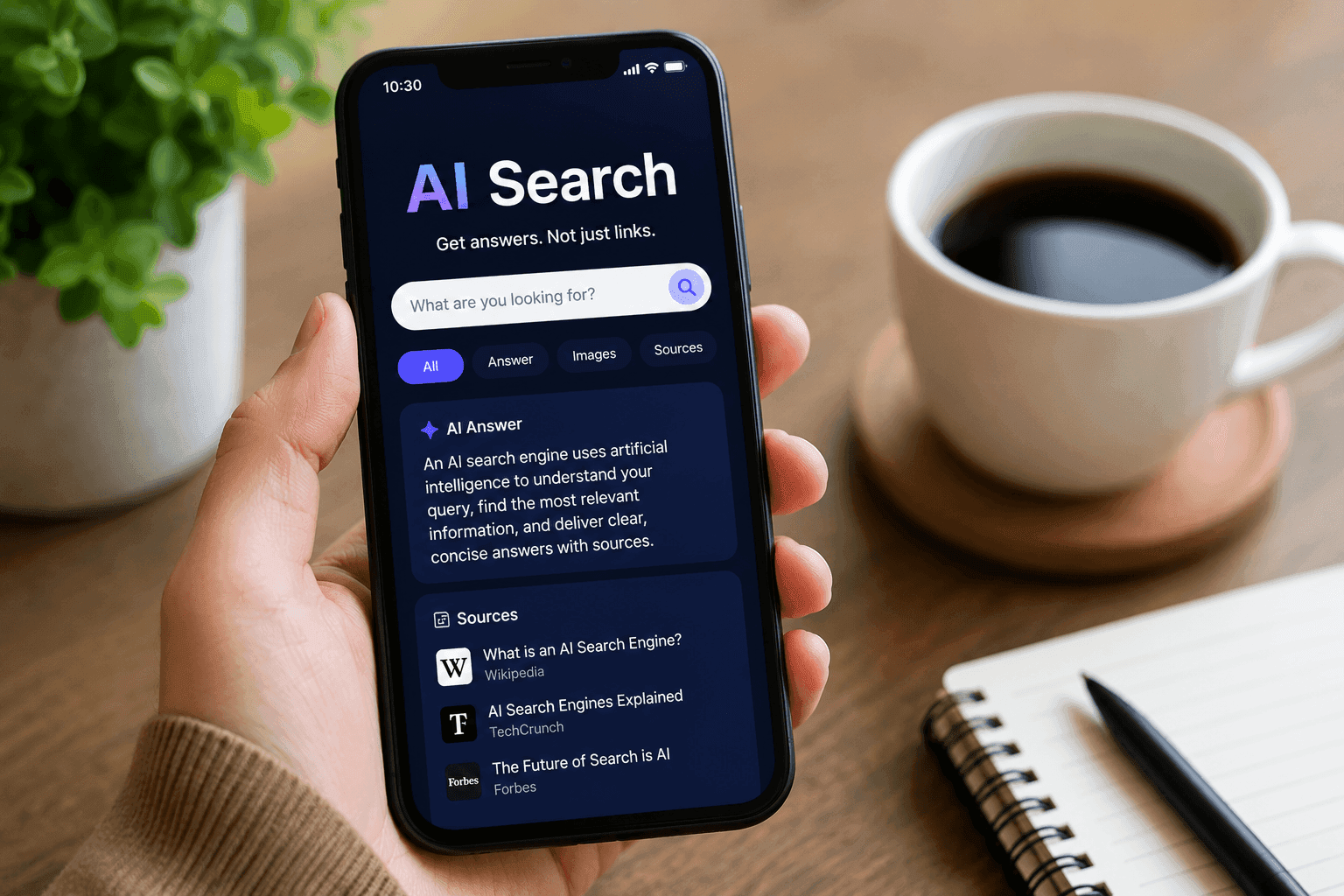
What is an AI Search Engine? (And Why Your Website Needs One)
Most businesses invest heavily in landing page optimization and SEO to drive traffic. Yet, the search bar—one of the most direct indicators of user intent—is often neglected. For many, it remains a basic keyword matcher that frequently leads to the dreaded "No Results Found" page.
To improve the user experience, you need to move beyond simple keyword matching. An ai search engine for your website is more than a tool; it is a semantic search layer that interprets natural language to help users find answers and pages faster.
What is an AI Search Engine?
At its core, an AI search engine focuses on meaning rather than characters. While a standard search bar looks for exact word matches, an AI search engine understands the intent behind the query.
The Shift from Keyword Matching to Semantic Understanding
Traditional search relies on "lexical search." For example, if a user searches for "how to connect my store," but your page is titled "Shopify Integration Guide," a traditional search might fail because the exact phrase isn't present.
Semantic search understands that "connect" and "integration" are related concepts. By interpreting meaning and context, it ensures users find the right information without having to guess the perfect internal terminology.
Web-Scale AI Search vs. On-Site AI Search
When people think of AI search, they often think of general-purpose tools like Bing AI. These are web-scale engines designed to crawl the entire internet. However, for a B2B company, the real value lies in on-site AI search.
While a general chatbot provides broad knowledge, an on-site AI search engine focuses exclusively on your verified data—your documentation, FAQs, and product pages. This transforms your site into a AI-powered semantic search layer that provides precise, company-specific answers.
Why Traditional Site Search Fails Your Visitors
Many companies organize their websites based on internal organizational charts rather than how users actually think. Users don't navigate by categories; they navigate by questions and problems.
The 'No Results Found' Dead End
When a visitor uses your search bar, they are expressing a high-intent action. A "No Results Found" page is a dead end that directly impacts your pipeline and customer trust. When users can't find an answer, they either bounce or submit a support ticket, increasing the load on your team.
The Burden of Perfect Keywords
Traditional search puts the burden of discovery on the user. If a customer searches for "payment failure" but your documentation uses the term "billing discrepancy," the search fails. This friction creates a barrier between your content and your customers.
How AI Search Engines Actually Work
Modern AI search doesn't just index words; it indexes concepts. This is achieved through several key technologies:
Understanding User Intent and Meaning
Using natural language processing (NLP) and vector search, the engine converts queries into mathematical representations of meaning (vectors). This allows the system to identify a match based on the concept of the query, even if the words are different.
Answer-First Results: The Power of RAG
Instead of a long list of links, an AI search engine uses Retrieval-Augmented Generation (RAG). This provides an "answer-first" experience. The AI identifies the most relevant information from your site and synthesizes a direct response, backed by clickable sources. This ensures transparency, as users can verify the answer against your original content.
Continuous Learning through Search Data
An AI search engine provides content intelligence. By analyzing search intent data, search failures are no longer just a UX problem—they become a roadmap for new content. If 100 people search for "API rate limits" and find nothing, you know exactly what to document next.
The Business Impact of Intelligent Discovery
Implementing an intelligent discovery layer shifts the experience from static browsing to an intuitive, conversational interface.
Reducing Support Tickets via Self-Serve Answers
By providing instant, accurate answers, you can turn documentation into a self-serve experience, effectively deflecting repetitive tickets. When users find the answer themselves, they feel more empowered and satisfied.
Increasing Conversion by Shortening the Path to Purchase
When a user finds the exact product or help article they need in seconds, the path to purchase is shortened. By helping users improve user journeys with better discovery, you remove the friction that leads to drop-offs.
Identifying Content Gaps with Search Intelligence
Analyzing what people are searching for—and what they can't find—allows your content and SEO teams to fix content gaps based on real user demand on-site.
Choosing the Right AI Search Layer for Your Site
When evaluating a search solution, avoid the hype and focus on practical outcomes.
Integration Effort vs. Performance
Look for a solution that plugs into your existing knowledge base with minimal disruption. The goal is to provide a high-performance search experience without a complete website overhaul.
Transparency and Source Verification
Because AI can sometimes hallucinate, it is critical that your search engine shows its sources. A credible search layer must always provide links to the original pages where the answer was derived, ensuring the user can verify the information.
Checklist: Is Your Current Search Failing You?
- Do you have a high percentage of "No Results Found" pages?
- Do you have support tickets for questions already answered in your docs?
- Do you feel your site structure is based on internal organization rather than user questions?
- Does your search bar only work if the user types the exact keyword?
- Are you ignoring your search bar as a conversion tool?
FAQ
What is the difference between a traditional search engine and an AI search engine?
Traditional search engines match keywords exactly. AI search engines use semantic search to understand the meaning and intent behind a query, providing more relevant results even if the exact words aren't used.
How does semantic search improve the user experience on a business website?
Semantic search removes the friction of guessing keywords. "Connect my store" becomes a relevant search for "Shopify Integration Guide," reducing bounce rates and unnecessary search effort.
Can an AI search engine help reduce customer support volume?
Yes. By providing an "answer-first" experience through your documentation and FAQs, users can find the exact information they need instantly, which deflects repetitive support tickets.
How do AI search engines handle natural language queries compared to keywords?
AI search engines use natural language processing (NLP) to interpret the context and meaning of a query. Instead of looking for a word-match, they find the content that best matches the intent of the user's question.
Experience a search layer that understands your users—Try Seekrs today.