Semantic Search for Websites: How Intent-Driven Search Improves User Experience
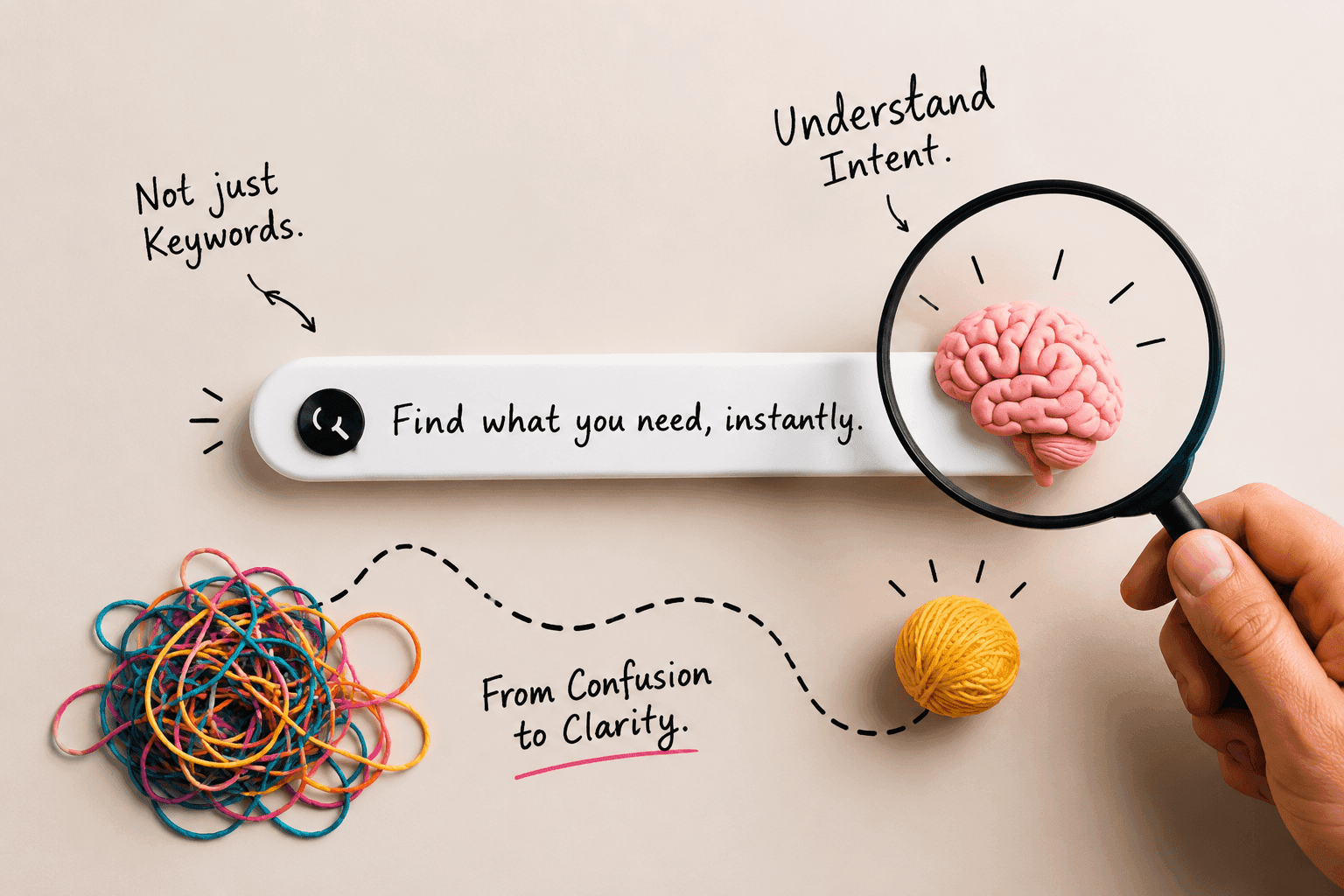
Most website visitors don't use the same terminology as your internal team. They don't know your content hierarchy or the specific keywords that trigger a result. When a user types a query into a search bar, they aren't looking for a word match; they are looking for a solution to a problem.
Implementing semantic search for websites transforms your search bar from a basic utility into an intelligent assistant that understands intent and meaning, bridging the gap between how users speak and how your content is written.
What semantic search really means
From keyword matching to intent understanding
Traditional site search relies on keyword matching. If a user searches for "coffee maker," the system looks for pages containing that exact phrase. If your page is titled "Brewing Equipment," the user might see zero results, even though the content is exactly what they need.
Semantic search changes this. By using natural language processing (NLP) and vector embeddings, it understands the meaning behind the query. It recognizes that "coffee maker" and "brewing equipment" are conceptually related. This allows the search layer to return the most relevant pages, regardless of the exact words used.
Core components: embeddings, context, and source attribution
To achieve this, semantic search uses vector embeddings—mathematical representations of words and concepts. Instead of searching for strings of text, the system searches for concepts in a multi-dimensional space.
However, meaning is nothing without trust. This is why Seekrs semantic search emphasizes source attribution. Every answer provided is backed by a clickable source, ensuring the AI doesn't just "guess" but provides a verifiable answer based on your own website's data.
Why traditional site search falls short
Lost conversions when users can’t find answers
When a visitor cannot find a specific answer, they rarely stay to browse your menus. In an era where users are accustomed to the instant, conversational answers provided by LLMs, they expect the same efficiency from your website. If your search bar fails them, they bounce to a competitor who makes discovery effortless.
The cost of dead-end queries and support tickets
Every "zero-result" page is a lost opportunity. More importantly, every time a user can't find a simple answer in your documentation or FAQ, they submit a support ticket. For example, a user searching for "how to reset password" might trigger a support ticket if the search bar fails to find the "Account Recovery" page.
This creates a cycle of repetitive tasks for your support team, inflating operational costs and slowing down the resolution time for complex issues.
How Seekrs applies semantic search to websites
Seekrs acts as an AI-powered semantic search layer that plugs into your existing site. It doesn't just list links; it provides a comprehensive discovery experience.
Answer-first responses with clickable sources
Instead of forcing users to click through five different pages to find a sentence, Seekrs delivers an answer-first response. The system interprets the query, finds the relevant information across your site, and presents a concise answer immediately. To maintain transparency, it provides the exact source link, allowing users to verify the answer and dive deeper into the context.
Intent-aware autocomplete and related queries
Discovery is often a guessing game for users. Seekrs provides intent-aware autocomplete that guides users as they type, suggesting relevant paths based on the meaning of their query rather than just the first few letters. This reduces the friction of discovery and guides the user toward a successful outcome.
Content intelligence that surfaces gaps and opportunities
Traditional search analytics tell you what words people typed. Seekrs provides content intelligence. It highlights what people are searching for but cannot find, identifying "zero-result" queries and tracking impressions and click-through rates.
For instance, if you notice a spike in queries for "enterprise pricing plans" that return no results, you know exactly where your content gap exists. This data allows content and SEO teams to see exactly what new pages or help articles you need to write.
Practical implementation steps
To move from a keyword-based system to an intent-driven one, follow these steps:
Plug-and-play integration with existing CMS or knowledge base
Integration is designed to be lightweight. You don't need a heavy re-indexing process or a massive data migration. By adding a simple snippet to your site, you can see how Seekrs integrates with your website and start indexing your content for semantic understanding.
Customizing ranking and answer formatting for your brand voice
Once integrated, you can refine how answers are presented. You can ensure the tone remains professional and helpful, avoiding the "AI hype" and focusing on practical outcomes. The goal is to make the search experience feel like a natural extension of your brand's voice.
Monitoring performance: click-through, answer accuracy, and deflection rates
Success is measured by outcomes, not just the number of searches. Monitor these key metrics:
- Zero-result reduction: How many queries that previously returned nothing are now returning relevant results?
- Search deflection: How many support tickets are being avoided because users found the answer instantly?
- Click-through rate (CTR): Are users users clicking through to the full pages for more detail?
Measuring the impact on user experience and business goals
Reduced bounce and increased time on page
When users find what they need quickly, they stay. By transforming the search box from a utility into a primary experience layer, you reduce bounce rates and increase the time users spend engaging with your high-value content.
Lower support ticket volume and faster resolution
By providing instant, accurate answers to common questions, you deflect repetitive tickets. This allows your support team to focus on high-impact, complex problems rather than answering the same "How do I..." questions dozens of times a day.
Insights for content and SEO teams from real search intent data
Semantic search provides a window into the user's mind. Instead of seeing a list of keywords, you see the intent behind the search. This allows your SEO team to optimize for the actual problems users are trying to solve, rather than just targeting high-volume keywords.
Frequently asked questions
Do I need to retrain models for my industry?
No. Seekrs uses pre-trained semantic models that understand general language and context. It understands the meaning of your content and the user's query without requiring industry-specific retraining.
How does Seekrs handle multilingual queries?
Seekrs provides multilingual support, allowing it to understand the intent of queries in different languages and return the most relevant content from your site, regardless of the phrasing.
What level of technical effort is required for installation?
Installation is a plug-and-play process. It requires only a lightweight snippet of code, meaning you don't have to perform heavy data migrations or re-index your entire site manually.
What business metrics improve after adding an intent-aware search layer?
You will typically see a reduction in support ticket volume (search deflection), and a decrease in zero-result pages, and an increase in overall user conversion rates as discovery becomes effortless.
How does Seekrs deliver instant answers while showing sources?
Seekrs uses a semantic search layer to identify the most relevant sections of your content. It then generates a concise answer based only on that content and provides a clickable link to the exact source page for transparency and trust.
Conclusion
Your search bar should be able to understand problems, not just match keywords. In a world where users expect instant, and accurate information, an intent-driven search experience is no longer a luxury—it is a primary layer of your website's user experience. Explore Seekrs features and use cases to see how you can turn your search bar into a knowledgeable assistant that guides your visitors toward the same success as your best sales representative.